 China AI Hub
Technology / AI Infrastructure in China: Clusters, Power, Constraints
AI Infrastructure in China: Clusters, Power, Constraints
AI infrastructure is the systems layer beneath models — compute clusters, storage, networking, and the serving software — that turns raw hardware into a service developers can call.
Technical background
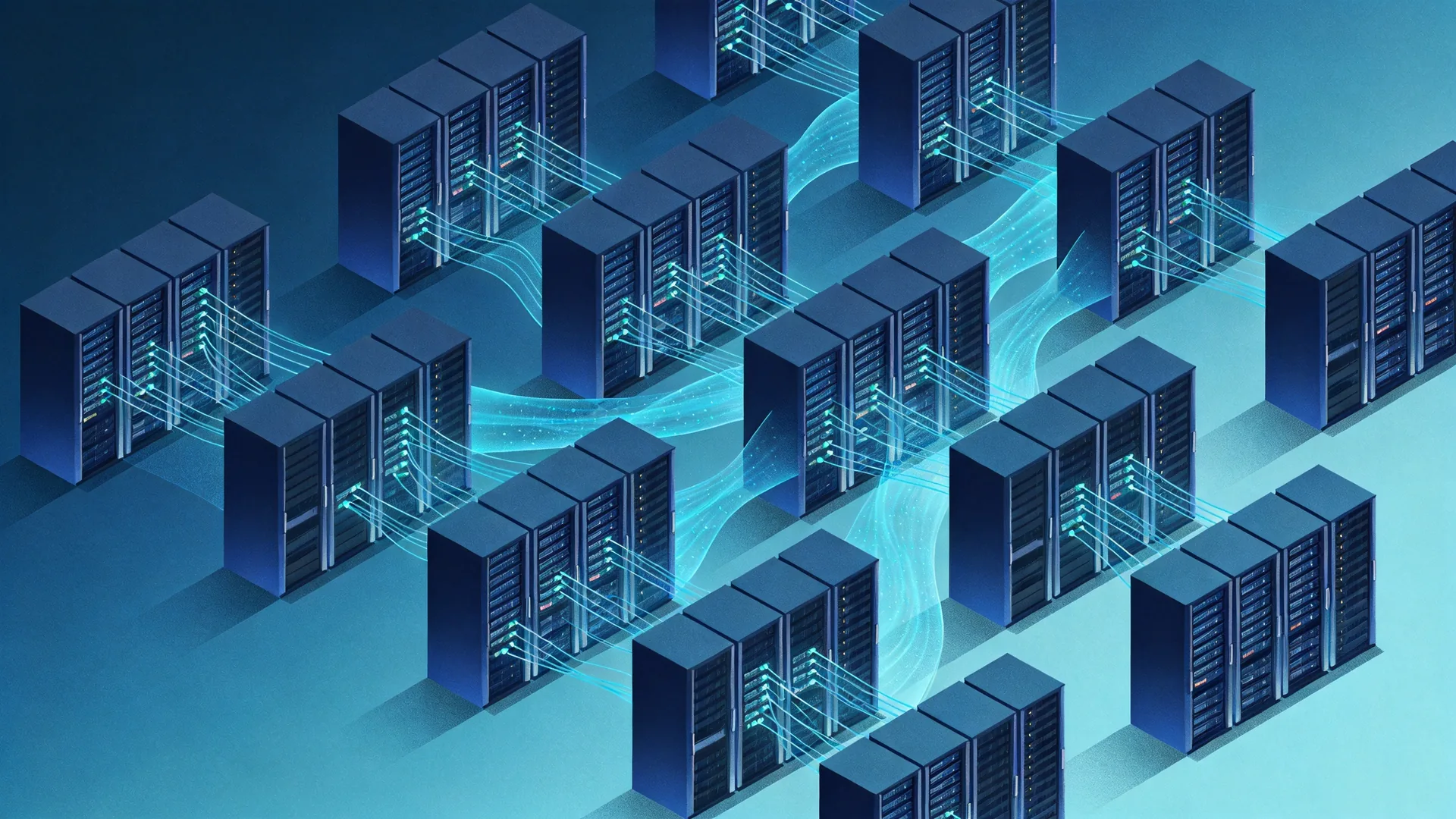
Training a frontier model means orchestrating thousands of accelerators across racks — parallelization strategy, checkpointing, fault tolerance, and interconnect. DeepSeek-V3’s technical report is a reference document for doing this cost-effectively: it details an H800 cluster, FP8 training, and cluster-scale engineering decisions that contributed to unusually low reported training costs. On the serving side, open runtimes like vLLM became the industry default.
How it works
Three layers. Compute: accelerators organized by interconnect (NVLink/HCCS/InfiniBand-class fabrics). Systems: distributed training frameworks, schedulers, storage (DeepSeek’s 3FS is a purpose-built distributed filesystem). Serving: runtimes (vLLM-class) with batching, paging and caching. Inference infrastructure for reasoning models adds a twist: long, bursty decode phases that reward speculative decoding and disaggregation.
Why it matters
Infrastructure converts model capability into availability and price. The Chinese API market’s price floor (DeepSeek’s $0.15/1M input flash tier, off-peak discounts, per our database) is an infrastructure achievement as much as a model achievement.
Chinese adoption
Chinese labs open-source infrastructure unusually aggressively. DeepSeek’s project list includes FlashMLA (attention kernel), DeepGEMM (GEMM library), DeepEP (expert-parallel communication) and 3FS (filesystem) — tools the community uses to serve open models at scale. MiniMax open-sources sparse-attention components (MSA). Combined with open weights (MIT/Apache-2.0 models from DeepSeek and Zhipu in our database), this makes self-hosted Chinese-model stacks viable outside China. The price floor this enables is concrete: DeepSeek-V4.1-Flash lists $0.15/1M input and GLM-5.3-Flash $0.15/1M input in the database, the lowest budget tier recorded.
Major Chinese companies and models
- DeepSeek — FlashMLA, DeepGEMM, DeepEP, 3FS open infrastructure; V3 technical report documents cluster-scale cost engineering.
- MiniMax — MSA sparse attention for long-context serving efficiency.
Practical applications
Self-hosting open-weight models, building cost-controlled internal API endpoints, batch/off-peak processing, and on-premises deployments with data-residency constraints.
Limitations
Cluster engineering is hard to replicate (reports omit operational details); open-source kernels demand integration work; and infrastructure advantages erode quickly as the field standardizes.
Deployment considerations
Start with managed serving unless scale justifies the ops burden; adopt the open kernels only where they match your runtime; and treat vendor infrastructure announcements as engineering signals, not product guarantees.
What the available evidence actually shows
The database records open infrastructure projects as company-level facts (DeepSeek’s FlashMLA/DeepGEMM/DeepEP/3FS; MiniMax’s MSA) and open weights as model-level facts (DeepSeek-V4-Pro and V4.1-Flash MIT; GLM-5.2/5.3 Apache-2.0), so the claim that Chinese-model self-hosting is practical is directly evidenced. What is not evidenced is the operational economics: the DeepSeek-V3 technical report documents cluster engineering but omits the operational details that determine whether a given team can reproduce those results. China AI Hub analysis indicates the open-infrastructure signal is strong and unusual — few Western labs release kernel-level inference libraries — but treat it as an engineering signal, not a guarantee that any specific self-hosting deployment will hit the database’s listed price floor.
Future development
Expect continued open-sourcing of inference kernels, disaggregated serving architectures, and infrastructure tuned specifically for long-reasoning workloads.
Labels used above: Official fact (from the DeepSeek-V3 technical report, vLLM, and the China AI Hub database), and China AI Hub analysis (our synthesis, always introduced as such).